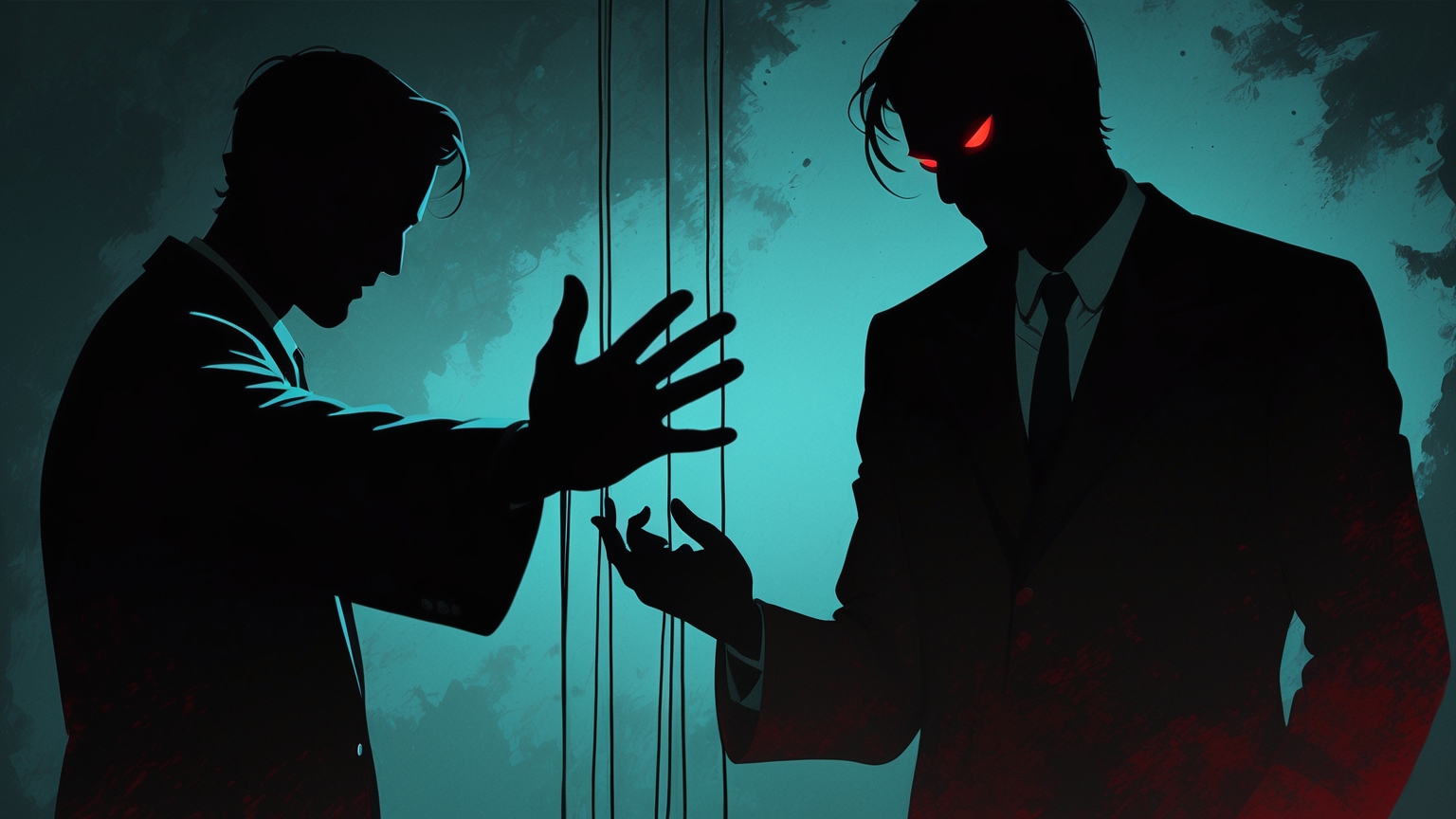
The villain who needs a master is dangerous. The villain who is his own master is terrifying. And the difference between the two is the single most important distinction in radicalization research.
Darth Vader required Palpatine — a decades-long grooming operation, systematic isolation, and a final crisis engineered to push him past the threshold. Remove Palpatine and Anakin Skywalker probably lives and dies as a complicated Jedi with attachment issues. But remove every external actor from Thanos's story and the outcome does not change. He arrives at the same conclusion. He executes the same plan. No recruiter. No handler. No cult. Just a man alone with a grievance, a genuine insight, and enough uninterrupted time to turn that insight into genocide.
This is self-radicalization. And it is the pathway that keeps counter-terrorism researchers up at night — because there is no external actor to identify, no communication to intercept, no network to disrupt.
The Moghaddam Staircase: Six Floors to Atrocity
Fathali Moghaddam's staircase model of terrorism describes radicalization as a six-stage narrowing — a building where each floor has fewer doors and fewer people. Most individuals never leave the ground floor. The ones who reach the top are not different in kind. They are different in trajectory.
Thanos climbs every floor without a guide.
Ground floor: Perceived deprivation. Titan was dying. Resources were finite. The population was unsustainable. This was not paranoia — it was observable reality. Most people who experience genuine deprivation stay here. They grieve, adapt, or advocate within existing structures.
First floor: Perceived injustice. Thanos proposed a solution and was called a madman. The experience of being right and dismissed — of watching the catastrophe arrive exactly as predicted — transforms deprivation into injustice. They chose not to solve it. Now they are dead and he is alive.
Second floor: Moral engagement. The individual decides the problem is not just real but morally intolerable — and that existing authorities have forfeited their right to solve it. Thanos concluded that the universe's resource problem was his to solve, because everyone with the authority to act had proven they would not.
Third floor: Solidification of ideology. The method crystallizes. Random, dispassionate, half. Not targeted. Not vindictive. Mathematical. Ideology at this stage is not belief. It is engineering.
Fourth floor: The categorical imperative. The mission outweighs any individual. Gamora. The Black Order. Thanos himself. He wept when he killed Gamora. But the tears did not slow the arm. Personal pain is irrelevant to operational necessity. The mission is the only surviving moral entity.
Fifth floor: Action. The snap. No hesitation. The staircase has narrowed to a single door and the person walks through it because every prior floor made this floor feel inevitable.
Moghaddam's model was built to describe terrorist cells and recruited operatives. Thanos climbed every floor alone.
The Echo Chamber of One
Clark McCauley and Sophia Moskalenko's research on radicalization challenges the assumption that extremism requires a group. Their work identifies a mechanism that operates entirely within a single mind: the echo chamber of one. A person alone with a grievance, without disconfirming social input, can radicalize through internal dialogue — the same way a person talks themselves into progressively more extreme positions in a late-night argument with no opponent.
The critical variable is not ideology. It is the absence of social correction.
Thanos had no inner circle that functioned as a check on his reasoning. The Black Order were executors, not advisors. Ebony Maw worshipped. Proxima Midnight obeyed. None of them occupied the role that matters most in preventing radicalization: the trusted voice that says "your analysis is correct, but your conclusion does not follow."
Gamora occupied that role briefly. She challenged the premise. And Thanos dismissed her — not with anger, but with the patient condescension of a person who has run the argument a thousand times inside his own head. That dismissal is the signature of the echo chamber of one. External input is not rejected because it is wrong. It is rejected because it has already been considered and defeated in the internal dialogue — a dialogue with no real opponent and no mechanism for updating the conclusion.
FBI and MI5 research on lone-actor terrorists — synthesized by Paul Gill, John Horgan, and Emily Corner — confirms the pattern: grievance, isolation, ideology, planning, action. The lone actor is not someone without purpose. It is someone whose purpose was never subjected to social correction. Gill's research is explicit: the base rate of serious mental illness among lone actors is not significantly higher than in the general population. What is significantly higher is social isolation and the absence of relationships that challenge core beliefs. The vulnerability is not in the mind. It is in the environment around it.
The Feedback Loop: When Partial Evidence Becomes Total Conviction
Thanos balanced multiple planets before Earth. Each one appeared to validate his method. Gamora's homeworld — "going to bed hungry, scrounging for scraps... now the children have full bellies." The survivors seemed to thrive. The data supported the thesis.
This is the most dangerous form of confirmation: empirical evidence that appears to support the model, without longitudinal data or alternative explanations. Like a gambler on a winning streak who concludes the system works. Like a founder who interprets three quarters of growth as validation of strategy without accounting for market conditions.
Philip Tetlock's research on expert judgment demonstrates that the forecasters who perform worst are those who have a single grand theory and interpret all evidence through it. The ones who perform best maintain multiple competing hypotheses and update continuously. Thanos had one theory. Every planet he balanced produced short-term data that appeared consistent with it. And because no one in his orbit had the standing to offer an alternative interpretation — that perhaps short-term improvements were attributable to resource redistribution rather than population reduction — the feedback loop closed and locked.
Any rigorous decision framework builds in mechanisms for exactly this failure mode: the requirement to seek disconfirming evidence before concluding that confirming evidence is sufficient. Thanos had no such mechanism. He had results that looked like proof, and no one with the authority to suggest they might be coincidence.
The Self-Grooming Contrast: Why No Palpatine Is Worse
The Vader pathway is terrifying but structurally simpler. Palpatine selected a target, isolated him, desensitized him, manufactured a crisis, and presented himself as the only solution. Remove Palpatine and the architecture collapses. There is an external actor — identifiable, interruptible, prosecutable.
Thanos performed every one of these operations on himself.
He selected his own mission. No handler pointed him at resource scarcity. He isolated himself ideologically. Not physically — he commanded armies and interacted with thousands. But he permitted no genuine intellectual challenge to his core premise. He desensitized himself to the violence through repeated practice. Each planet was an incremental expansion of what he was willing to do. By the time he reached for the Stones, killing trillions was a scaling problem, not a moral one. He manufactured his own urgency. The ticking clock was his, built from Titan's collapse and projected onto every civilization. He positioned himself as the only solution. "I am the only one with the will to act."
Self-grooming is harder to detect, harder to prevent, and harder to reverse — because the recruiter and the recruit are the same person. The handler and the asset share a skull. Counter-terrorism frameworks built around disrupting networks have no purchase on a mind that radicalized in solitude.
This is why researchers like Bart Schuurman emphasize that the lone-actor problem is fundamentally different from organized terrorism — not in lethality, but in preventability. The self-radicalized individual can only be reached through competitive intelligence about their behavior patterns — observable changes in isolation, rhetoric, and preparation — before the staircase reaches the top floor.
Real-World Echoes
The Thanos pattern does not require cosmic power to operate.
Lone-actor mass violence follows the self-radicalization pathway with documented consistency. Individuals who develop grievances and process them in isolation — through online echo chambers or private rumination — until ideology provides justification and planning provides method. The manifesto is the tell. It is always internally consistent. It always positions the actor as the reluctant hero. The architecture is Thanos without the CGI.
Founders who lose board-level checks exhibit the same trajectory at corporate scale. A genuine insight validated early by success, reinforced by a culture that rewards conviction over questioning, until the founder's judgment becomes unfalsifiable within the organization. The advisors who disagree are dismissed. The echo chamber narrows to one.
Leaders who mistake agreement for validation. The executive whose direct reports have learned that disagreement is punished. The community leader surrounded by loyalists. In each case, the absence of opposition does not mean the leader is right. It means the environment has been shaped to prevent the leader from being wrong.
The Protocol
Self-radicalization is invisible from the inside because the architecture was built by the same mind that inhabits it. The defense requires external structure that the internal process cannot override.
-
Institute a mandatory devil's advocate in every high-conviction decision. Not someone who agrees to play the role temporarily — a person whose structural function is to challenge your strongest beliefs with your own evidence. If no one in your orbit can articulate the best case against your position, your position has not been tested. It has been rehearsed.
-
Audit your feedback loops for confirmation masquerading as validation. List the evidence supporting your current course. Then ask: what alternative explanations exist for each data point? If you cannot generate at least two alternatives for your strongest evidence, the echo chamber has already closed. Tetlock's superforecasters succeed because they hold multiple hypotheses simultaneously. Thanos held one.
-
Track your isolation trajectory quarterly. Count the people who genuinely challenge your thinking — not your decisions, your thinking. If that number has decreased over the past year, the decrease is the signal. It does not matter whether the decrease feels justified. Every self-radicalized individual believed their isolation was rational.
-
Subject your conclusions to the people they affect. Thanos never asked. He decided for trillions. The test for any high-stakes conclusion is whether it can survive scrutiny from those who will bear its consequences. If the conclusion requires bypassing that scrutiny, it is not strong enough to justify the consequences.
-
Separate your grievance from your prescription — permanently. The grievance may be legitimate. Titan did collapse. Resources are finite. But diagnosis does not validate prescription. "The problem is real" and "my solution is correct" are two separate claims requiring separate evidence. The moment they fuse — the moment questioning your method feels identical to denying the problem — the staircase has narrowed and you are climbing.
The scariest villain in fiction is not the one who was corrupted by another. It is the one who corrupted himself — methodically, rationally, through a process that looked like clear thinking at every stage and produced genocide at the end. Thanos needed no Palpatine because the most dangerous echo chamber has no walls, no membership, and no exit. It is the space between a person's ears when no other voice can reach them.
The darkness that requires a manipulator can be prevented by removing the manipulator. The darkness that builds itself can only be prevented by building something stronger in its place: relationships that challenge, structures that check, and the discipline to treat your own certainty as the most dangerous variable in the room.
Never let yourself be the only voice you trust.