
There is a pattern that shows up everywhere — in debugging sessions that stretch into the night, in job searches that drag across eighteen months, in relationships that keep having the same fight.
You hit a wall. You push harder. The wall doesn't move. You push harder again.
By the third attempt, you are not solving the problem anymore. You are executing a ritual. Going through the motions because stopping feels like admitting defeat.
This is not persistence. This is thrashing. And the cost is enormous.
The Trap Has a Name
Behavioral economists call it the sunk cost fallacy. Your brain does not evaluate decisions based on their future value — it evaluates them based on how much you have already invested. The more you have put in, the harder it becomes to walk away, even when the evidence is screaming at you to.
When you hit failure the first time, you adapt. You adjust the execution. That is rational. That is how learning works.
When you hit failure the second time with the same underlying approach, something different is happening. The problem is not your execution anymore. The problem is the approach itself. But your brain does not register that distinction cleanly — it registers the emotional weight of everything you have already spent, and it tells you to keep going because stopping would make that investment meaningless.
This is the trap. And most people live inside it for years without recognizing it.
Persistence vs. Thrashing
These two words are used interchangeably, but they describe completely different cognitive states.
Persistence is iterating on a valid approach. You are refining, adjusting, learning from each cycle. The direction is sound — you are working the execution. This is productive. This is how breakthroughs happen.
Thrashing is repeating an invalid approach with increasing intensity. The direction is fundamentally wrong, but you have mistaken effort for progress. Each cycle burns resources without generating real signal. You are running faster in the wrong direction.
The external behavior looks almost identical. Both involve continued effort after failure. The difference is whether the underlying approach has been validated or invalidated.
After one failure, you have insufficient data. The approach might still be sound. After two failures with the same approach, the approach has returned a verdict. You now have enough data.
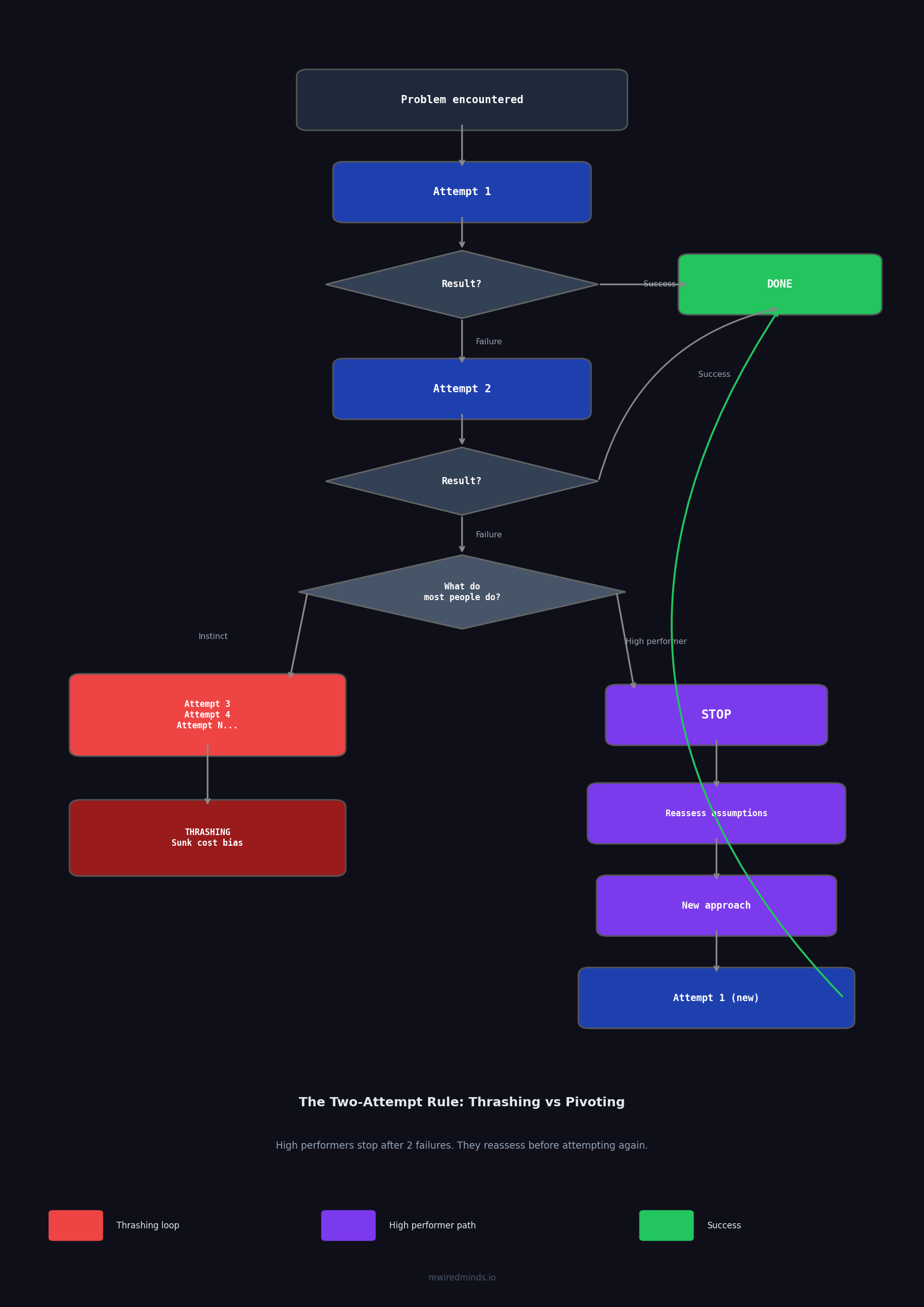
Two Attempts Are Enough Data
This is the core claim, and it is worth sitting with.
Two attempts at the same approach, both returning failure, tells you something specific: the problem is architectural. Not tactical. You are not one more push away from success — you are staring at a structural mismatch between your method and the problem.
Watch what happens in production systems when an automated process fails. A well-designed system retries once — because transient errors exist, and a single failure can be noise. It retries twice at most. If both attempts fail, the system does not attempt a third. It escalates. It alerts. It stops and hands the problem to a different process.
The engineering reasoning is exact: after two failures, the system has confirmed this is not a transient error. Continuing the same retry loop does not collect more information — it just burns cycles and delays resolution. The only productive move is to change the approach.
Human brains need the same circuit breaker. We just rarely build one.
The Protocol
High performers who operate at sustained output have internalized a specific pattern. Run this after the second failure — not the third.
- Name what failed — in one sentence, within 5 minutes. Not "it didn't work." Specifically: what was the approach, and what was the failure mode? Vague failure descriptions lead to vague pivots. Write it down before your brain starts rationalizing.
- Audit the assumptions — list every one. Every approach rests on assumptions. Which assumption did you make that the failure is calling into question? This is the diagnostic step most people skip — they go straight from "it failed" to "try harder." Write each assumption as a testable statement.
- Classify the constraint — external, internal, or architectural. Is the problem external (the environment won't cooperate), internal (you lack a specific capability), or architectural (the approach is wrong for this problem structure)? This classification determines whether you adjust, upskill, or pivot. Any real decision framework forces this distinction — because the intervention depends entirely on the diagnosis.
- Generate a genuinely different approach — not a variation. Different means different first principles, not just different execution. If your new plan shares the same core assumption as the failed one, you haven't pivoted. You've rebranded.
- Set the next attempt threshold before you start. Decide now: if this new approach fails twice, you will stop again. You are building the circuit breaker in advance, not in the heat of failure.
The protocol sounds clinical when written out. That is the point. When you are inside a failure loop, emotion compromises your reasoning. Having a predetermined protocol removes the judgment call.
The Cognitive Shift
Here is the reframe that changes everything: reassessment is the work.
When you stop and replan after two failures, you are not pausing the work. You are doing the most important part of the work. You are generating the information that makes all future effort coherent.
The people who keep pushing past two failures tell themselves they cannot afford to stop. In reality, they cannot afford not to. Every additional attempt on a broken approach is negative-return effort — it does not just fail to produce progress, it actively consumes time, energy, and morale that could fuel the pivot.
The pause is not a cost. The pause is the investment that makes the next attempt productive.
Where This Shows Up
The pattern is not domain-specific. It appears anywhere humans apply effort to problems:
Debugging: The developer who spends eight hours convinced the bug is in layer A when it is in layer B. Two clear reproductions that point elsewhere are enough data to question the hypothesis.
Job search: Applying to the same role profile with the same positioning for six months. Two cycles of rejection with no response is a signal about the approach, not the candidate.
Negotiations: Two rounds with the same framing that land the same way. The framing is the problem, not the ask.
Creative work: A piece that fails twice with similar feedback. The structure has a flaw the execution cannot fix.
Relationships: The same conversation that produces the same outcome. The conversational approach needs to change, not the volume.
In each case, the emotional pull is toward more effort. The productive move is toward different effort.
The Paradox
The people who stop fastest often ship fastest.
This is counterintuitive until you map it out. The person who keeps pushing past two failures spends twelve hours on a broken approach before arriving at a pivot. The person who stops at two failures spends two hours, pivots, and arrives at a working solution in four.
Total time: twelve versus six. The stopper wins.
This compounds over a career. The practitioner who has internalized the two-attempt rule runs a fundamentally different error-correction loop. They generate signal faster, they waste fewer cycles, and they develop better intuition about what kinds of approaches work — because they have more data points from more diverse attempts.
The instinct to push through is not a personality flaw. It is a wiring artifact — your brain evolved in environments where persistence was often the correct response and stopping carried real costs. The modern problem landscape is different. Many of the walls you are hitting are not walls you can push through. They are walls you have to go around.
Two attempts is enough to know the difference.
Build the circuit breaker. Name the failure mode. Audit the assumptions. Pivot before the third attempt.
The work is in the reassessment. Not in the repetition.